Understand Mississippi Stud rules, five-card hand rankings, staged wagers, standard paytable examples, house edge and consumer risks.

Mississippi Stud Rules: Five-Card Hands, Paytable and Risks


Mississippi Stud rules describe a poker-derived casino table game in which a final five-card hand is evaluated against a published paytable. The player receives two private cards and sees three community cards revealed over successive stages. Unlike traditional head-to-head poker, the dealer does not make a competing hand. Understanding the distinction is essential to reading the payout rules accurately.
This US-focused guide explains the structure of Mississippi Stud, its hand categories, illustrative payouts, house-edge terminology and consumer safeguards. It does not recommend a wagering strategy or claim that any pattern can overcome the game’s built-in expected loss. Exact rules can vary, so published examples must not be mistaken for universal casino terms.
What Mississippi Stud Is—and What It Is Not
Mississippi Stud is a five-card poker-derived casino table game. It is not a contest in which a player tries to beat the dealer’s poker hand. Instead, a final hand made from two private cards and three community cards is compared with a fixed paytable. This distinction changes the meaning of a win, a push and a loss. A dealer manages the cards and settlement, but there is no dealer hand to outrank. The rules are straightforward to describe, yet the game can involve several separate wagers before the final card appears.
Descriptions sometimes call the game a form of stud poker because cards are revealed in stages. However, the casino version has a fixed commercial paytable, and the financial outcome depends on both the final five-card combination and the amounts already committed at earlier stages. A familiar poker ranking does not imply familiar Texas Hold’em rules. This article explains the mechanism and the financial exposure, without presenting a betting system or suggesting that participation can be profitable.
The Five-Card Layout and Three Streets
At the beginning of a standard hand, a player receives two private cards. Three community cards are placed face down. After the initial ante, the game offers three decisions in sequence, commonly called third street, fourth street and fifth street. Each decision occurs before the next community card is shown. The available choices are to fold or commit an additional wager within the stated table range. The final card is exposed only after the last of these decisions has been resolved.
On third street, only the two private cards are visible to the player. One community card is then exposed. On fourth street, the player sees three cards in total, and another community card is subsequently exposed. On fifth street, four cards are known, and the last community card completes the five-card hand. These stage labels refer to the order of cards and decisions; they are not independent poker games. The exact procedures should always be checked against the posted house rules.
What Folding and Continuing Mean Financially
Folding ends a hand and forfeits the ante plus any additional street wagers already committed. The amount lost therefore depends on when the fold occurs. Continuing requires another stake, which increases the amount exposed to the same eventual five-card result. This is a central risk characteristic: the price of reaching the final card can be materially greater than the initial ante. It is misleading to evaluate the game solely by a low advertised table minimum.
In the widely documented standard version, each of the three street wagers can range from one to three times the ante. A hypothetical $10 ante followed by the maximum $30 on each street would put $100 at risk by the time the hand is complete. This is arithmetic, not a recommended sequence. A person can lose the entire amount if the final hand is nonpaying. Some venues also impose maximum payouts or separate limits, so the posted terms matter.
Mississippi Stud Hand Rankings
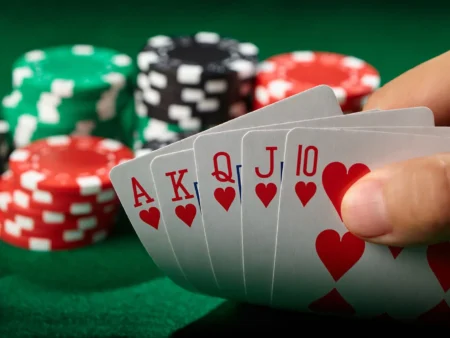
The final hand uses conventional five-card poker categories: royal flush, straight flush, four of a kind, full house, flush, straight, three of a kind, two pair, one pair and high card. A royal flush is a particular ace-high straight flush. The ranking tells you how rare or strong the combination is, but it does not by itself tell you the payout. For instance, the common Mississippi Stud paytable distinguishes a pair of jacks or better from a lower pair, even though both are simply one-pair hands in standard poker.
Another important distinction is that a pair of sixes through tens is commonly treated as a push, while a pair of twos through fives and an unpaired high-card hand are losing outcomes. A push generally means the relevant committed wagers are returned without a profit. A payout expressed as ‘to 1’ usually denotes net winnings relative to a wager, but the displayed return and treatment of stakes should be checked in the actual game rules.
Illustrative Standard Paytable
One commonly published schedule lists royal flush at 500 to 1, straight flush at 100 to 1, four of a kind at 40 to 1, full house at 10 to 1, flush at 6 to 1, straight at 4 to 1, three of a kind at 3 to 1, two pair at 2 to 1 and a pair of jacks or better at 1 to 1. A pair of sixes through tens pushes; all lower results lose. These numbers describe a documented example, not a promise about every casino, online product or jurisdiction.
The same hand category may be offered under different paytables or with an optional side bet. Those variations can change expected value, and an impressive top prize does not establish favorable overall mathematics. The relevant comparison is the complete set of outcomes, their probabilities and all the money committed across a hand. The Wizard of Odds Mississippi Stud analysis publishes a detailed standard schedule and mathematical model; an Ocean Casino Resort rules page independently illustrates the staged dealing procedure.
A Simple Example of the Settlement
Imagine a completed five-card hand containing a pair of queens and no stronger combination. Under the illustrative standard schedule, this falls in the pair-of-jacks-or-better category, listed at 1 to 1. By contrast, a completed pair of eights is in the push category, and a pair of fours is a losing result. The hand itself determines the category; the amounts placed on the ante and each street determine the total amount affected by that result.
The key lesson is not that one outcome is due after another, but that similar-looking hands can settle differently. A pair of queens and a pair of eights are both one-pair hands in ordinary poker. In this game, their settlement differs because the paytable sets an additional threshold. It is also important not to confuse a payout multiplier with a probability: a large multiplier is associated with a rare outcome, and rarity alone does not imply a positive expectation.
House Edge Versus Element of Risk
House edge is an average expected loss measure for a specified ruleset and decision policy. For the standard paytable analyzed by Wizard of Odds, the quoted house edge is approximately 4.91% of the initial ante under the model’s strategy assumptions. This figure is not a prediction of what any particular hand or visit will cost. A person may lose the full amount at risk or receive a rare payout; averages describe many hypothetical repetitions, not a guaranteed short-term result.
Analysts sometimes also describe an element of risk: expected loss divided by average total money wagered rather than the initial ante alone. Because Mississippi Stud can require several street wagers, these two denominators produce different percentages. Comparing the 4.91% ante-based figure with another game’s total-action percentage without checking definitions is misleading. Any numerical claim should name its paytable, assumptions and denominator. No house-edge statistic converts gambling into an income plan.
Why Side Bets Need Separate Treatment
Some versions include an optional three-card bonus based on the community cards or another separate feature. This is not the same calculation as the main five-card game. A side bet may have its own qualifying hands, payouts and expected loss, and it can settle independently of the main result. Mixing its advertised top prize into a discussion of the base game can exaggerate the apparent return. The only sound comparison uses the side bet’s complete published rules and probabilities.
An optional wager also increases the total amount that may be lost. That matters even when it has a small nominal stake. Casino marketing sometimes emphasizes special outcomes while leaving the frequency of losing outcomes less visible. For a neutral explanation, it is more useful to identify whether the wager is separate, what triggers settlement, and whether its paytable has been independently analyzed than to highlight the headline payout.
Common Misunderstandings About the Game
One misconception is that the dealer is trying to make a better hand. In standard Mississippi Stud, the dealer administers the game but does not compete with a separate hand. Another is that a pair always pays. The published example has different outcomes for pairs below six, pairs from six through ten and pairs of jacks or higher. A third misconception is that the minimum ante represents the full financial exposure. Multiple street wagers can make the actual amount much larger.
Previous results do not make a particular five-card combination ‘due’ next. Assuming independent shuffles or correctly implemented randomization, the outcome of a new hand is not made more favorable by a preceding loss. Similarly, raising or lowering stake sizes changes the size of financial exposure but does not change the probability distribution of the cards. Claims of a guaranteed winning sequence should be treated skeptically.
Checking Rules, Licensing and Consumer Protection
Before relying on any explanation, identify the jurisdiction and the exact version of the game. Read the table paytable, any cap on aggregate winnings, the treatment of pushes, and the rules governing bonus wagers. If the game is offered online, verify that the operator and game are authorized where the consumer is located. A website’s use of poker terminology or a generic ‘licensed’ badge is not proof of authorization in a particular US state.
People concerned about gambling-related harm can consult the National Council on Problem Gambling for information and support. A game with a negative long-run expected value should not be used to recover losses, cover expenses or pursue income. The most useful purpose of studying the mathematics is to understand the limitations of advertised payouts and the financial risks, not to increase participation.
Frequently Asked Questions
Ques: Does Mississippi Stud have a dealer hand? No. The player’s final five-card hand is settled against a posted paytable rather than compared with a competing dealer hand.
Ques: How many community cards are used? Three community cards are revealed in stages and combined with two private cards to make five cards.
Ques: Does a pair always pay? No. In the common schedule, a pair of sixes through tens pushes, a pair of jacks or higher pays, and a lower pair loses.
Ques: Is the 4.91% house edge universal? No. It applies to a specific standard paytable and modeling assumptions; variants can differ.
Ques: Can a hand involve more than the ante? Yes. Additional street wagers can substantially increase the total amount exposed.
Ques: Do previous hands affect the next deal? Not under independent random dealing; previous results do not create a guaranteed future outcome.
Conclusion
Mississippi Stud is best understood as a staged five-card paytable game, not a contest against a dealer’s poker hand. Its distinctive features are the two private cards, three progressively revealed community cards, repeated opportunities to fold or commit more money, and a paytable that treats different one-pair hands differently. Those features explain both the mechanics and why the initial ante can understate the full amount at risk.
The published standard paytable and house-edge figures provide useful reference points, but every comparison should be grounded in the actual rules of the game being described. No payout table, card pattern or decision framework eliminates uncertainty or financial loss risk. This article is educational, not an endorsement of gambling, a casino or a particular wagering method.